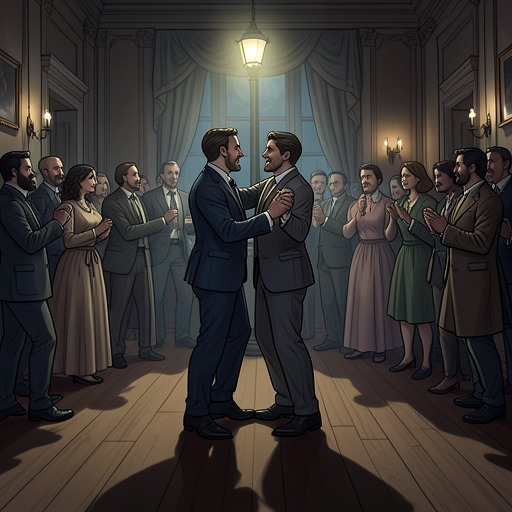
The Jets and Sharks agree to a duel
West Side StoryThe Jets and Sharks agree to a duel in a small restaurant, turning an open-ended gang rivalry into a contest with an appointed time, place, and fighters. The arrangement appears to promise a controlled, fair resolution, but the negotiations also reveal how little control its participants have over the loyalties and personal conflicts driving them: Tony Wyzek tries to prevent a weapons fight, Bernardo wants him drawn into the contest, and Riff Lorton chooses Diesel instead.
Background and Challenge
Bernardo arrives with the Sharks after Riff Lorton invites them into the restaurant. Bernardo looks around as if weighing whether the invitation conceals a trap, then signals for his group to follow him inside. The barman asks the visitors to keep their word not to cause trouble there. Riff, meanwhile, closes and locks the front door and looks out into the street for Tony. Tony is not yet in sight, and Riff recognizes that if Bernardo wants the confrontation to begin that evening, the Jets will have to meet it.
Riff makes the challenge explicit: he calls on Bernardo to settle matters once and for all. Bernardo accepts, but immediately asks what rules will govern the contest. Riff gives him the choice, saying that the Sharks may set the terms. The offer presents the encounter as a negotiated test rather than an ambush, though the parties are still speaking as leaders of rival gangs, each in front of his own supporters. Bernardo confirms that the Sharks accept and asks when the duel should take place. He proposes the following evening, a delay that pleases Riff because it gives him time to find Tony.
Time, Place, and Terms
Riff tries to seal the commitment by offering Bernardo his hand, at the same time presenting the agreement as an example of how a leader should behave. He asks whether the duel should be held in the park or by the river. Bernardo proposes Under the highway, and Riff accepts the location with a nod. The choice makes the agreement concrete: the fight is no longer only a challenge exchanged inside the restaurant but a planned event assigned to a particular place and time.
The question of weapons remains unsettled. When Riff asks what they will use, Tony, now present, says that the weapons are what matter to him. Riff suggests knives and guns, partly because he wants to impress Tony with his nerve. Tony responds by attacking the idea that either gang needs bricks, knives, or guns to prove itself. His challenge is not simply to fight; he insists that the men should be willing to face one another bodily, without weapons. Baby-John jokes that a street fight with only bodies would at least require throwing garbage cans, while Riff explains that the Jets intend to use their fists and have left the choice of weapons to the Sharks.
Tony presses the point further. In his view, both sides are using the possibility of weapons to evade a direct contest. He proposes that a fair fight could settle the matter if each gang can produce one fighter willing to meet the other with fists. This changes the terms of the proposed duel: the contest is narrowed from a clash in which weapons might be used to a one-on-one fistfight offered as a test of courage and fairness. The agreement does not dissolve the rivalry, but it gives the opposing groups a rule by which they can present the coming violence as controlled.
Choosing the Fighters
Bernardo welcomes Tony's proposal. His response carries an expectation that Tony might represent the Jets, and Bernardo appears to hope for that outcome. The possibility immediately unsettles the Sharks' side: Pepe protests that the others would be left merely watching, while Action bangs his empty coffee cup on the counter and refuses to stand aside, particularly if Tony is the opponent. Riff answers that the leaders make the decision, not the whole gathering. He accepts the fair-fight arrangement and asks Bernardo to seal it, but Bernardo says his word is sufficient for now.
Bernardo then proposes that there is no need to wait until the following evening; they could fight immediately. He pauses to look at Tony and tells him to meet under the highway. Riff rejects the implied selection of Tony. He signals Diesel forward and names him as the Jets' best fighter, reaffirming that the next evening suits his side. Bernardo's disappointment is visible as he indicates Tony, whose presence had seemed to promise a different matchup. When Riff asks whom Bernardo will choose, Bernardo answers that he will represent the Sharks himself. The leaders thus become the designated opponents, but not the opponents Bernardo initially appeared to want.
Stakes and Significance
The exchange is shaped by Tony's divided position. Earlier that evening he had hidden from the Jets; now he has sought them out, partly because of Bernardo and partly because he wants to defend his right to see Maria. He has left the Jets because he no longer wants to fight the Sharks, and he wants Bernardo to recognize that he has changed. Yet his attempt to redirect the confrontation draws him back into the gang's business: Bernardo looks to him as a possible Jets fighter, and Riff's refusal makes Tony's separation from the gang visible in the very act of choosing a substitute.
Bernardo's response also connects the public contest to his private opposition to Tony. After choosing to fight for the Sharks, he looks at Tony and decides that Maria will have to marry Chino sooner than he had planned. The duel agreement therefore produces an immediate consequence beyond its scheduled fight: Bernardo turns the challenge into a reason to accelerate his effort to determine Maria's future. What is presented as a fair settlement between gangs is already entangled with the forbidden relationship Tony is trying to defend.
The scene's central reversal lies in its promise of order. The leaders settle on a time, a neutral-seeming location, and a restriction to fists, replacing an uncertain weapons confrontation with agreed terms. Yet agreement is not reconciliation. The words and gestures that make the duel official—acceptance, a proposed time, a handshake over the location, and the leaders' selection of fighters—also sharpen the personal stakes. Tony argues for a contest that will keep weapons out of it, but he cannot make the decision about who fights or prevent Bernardo from using the confrontation to tighten his control over Maria's choices.